Tag: Historical Analysis

  • Music for a Modern Resistance

    Many people underestimate the power of music. Melodies that raise the hairs on your arms. Beats that sync up with your heart. Words that feel like they could have come from your own brain. Music is made with the intention to make you feel something. Whether it be the pain the musician is going through, the joy they’re experiencing, or the hope they are trying to inspire, they want to stir the listener’s emotions, hoping you feel the way they felt while creating their masterpiece. 

    For times of resistance, there is protest music. These compositions are made to keep you going, even when it feels like the fight is impossible. That music is made to help you feel less alone in your fight; to let you know that there are others in this journey with you. When everything around you feels like it’s falling apart and no one is noticing, resistance songs are there to let you know that you aren’t crazy.

    Protest music and resistance songs aren’t new. In fact, they’ve been around for centuries. In 1774, Dr. Joseph Warren wrote “Free Americay”, a popular song for the American Revolution against British tyranny. “Woodman, Spare That Tree!” by Henry Russell in 1837 was one of the first songs used to help advocate for environmentalism. The Hutchinson Family Singers created “Get Off The Track!”, a ballad that called for emancipation in 1844. A Pro-Suffrage song named “The Suffrage Flag” was written in 1884 by William. P. Atkinson proclaimed how much better the world would be when women were granted the right to vote (which wouldn’t happen for another 3 decades). Joe Hill, a labor activist, wrote “The Preacher and the Slave” in 1911 as a condemnation of the Salvation Army. There were songs that helped enslaved people find their way to freedom. Songs to reconnect those kidnapped people with the cultures they were robbed of, or deal with the grief of the family members they lost. These few songs are just a fraction of the protest music that emerged in the centuries leading up to the 21st, and every single one of them was important in its time. Some are still pertinent to the world we live in. (source)

    Cover depicts a gentleman talking to a farmer holding an axe underneath a large tree. The farmer’s house and water well are visible. Russell, Henry, 1812-1900 (Composer)
    Morris, George P. (Lyricist)

    Songs of resistance are still being made today. Music that tackles issues like women’s rights, healthcare reformation, and pushing back against harmful governments is alive and well in 2026. The main problem is that the musicians who create them are often overlooked in favor of popular mainstream artists whose only goal is to make another hit. Many radio stations stick to the fun songs, the dance tracks, the ballads about ex-lovers; anything that is deemed safe for the general population and won’t rock the boat with the people in charge. 

    Luckily, we no longer need to rely on radio stations that handpick the “more palatable” songs in an effort to keep us under a false sense of security or placate the conservative powers-that-be. We live in a modern age where we can discover new music from around the world and create our own playlists that reflect how we actually feel. Here are 5 songs for you to add to your modern resistance collection.

    “Labour” by Paris Paloma 
    Hard hitting lyrics:
    “All day, every day, therapist, mother, maid
    Nymph, then a virgin, nurse, then a servant
    Just an appendage, live to attend him
    So that he never lifts a finger
    24/7 baby machine
    So he can live out his picket-fence dreams
    It's not an act of love if you make her
    You make me do too much labour”
    “Take My Country Back” by Enter Shikari 
    Hard hitting lyrics:
    “Get up, get up and feel the rising tide
    I’m fed up, fed up with all the cyanide.
    Don’t want to take my country back
    I want to take my country forward”
    “Dead Men Don’t Rape” by Delilah Bon 
    Hard hitting lyrics:
    “They get so offended when I say
    Dead men don't rape
    But where is their anger when I say
    Women are women are women are dying”
    “THREAT LEVEL ORANGE” by Earth to Eve 
    Hard hitting lyrics:
    “Ain't it obvious
    The person in the office is
    A racist
    Bride came in the mail, but he opposes immigration
    That's someone's abuelita
    Not a foreign armed invasion
    That would be the masked men raiding graduation ceremonies
    Unmarked vans snatching people off the street
    Broke amendments 5, 10 and 14
    At least
    But please, tell me again how this is still democracy”
    “G-U-I-L-L-O-T-I-N-E” by HummusVacuum
    Hard hitting lyrics:
    “G-u-i-l-l-o-t-i-n-e
    Yeah, what might seem barbaric is a last resort to me
    ‘Cus we waited for our crumbs to trickle down so patiently
    And now we get to cosplay like it's 1933”

    Protest music hasn’t gone anywhere. Sometimes you just need to search a little harder to find it. When you do, let the beat lead your steps. Let the words give you the courage to continue the fight. Let the songs of resistance deliver the message that you, and we, are not alone in this revolution.

  • Education | Beyond the Celebration: Facing the Brutal Truths of Black History

    This Black History Month, let’s look at the history of the Black disenfranchisement of a community that built the country we call home.

    The struggle and generational trauma passed down in Black Communities started with The Middle Passage. The maritime journey that brought millions of Africans to the Americas was under brutal conditions.

    The country was built on the ownership of the people, and the government knew that.

    Millions suffered during The Middle Passage, and stories have been passed down through generations, paving the very month we recognize the Black Resistance and protest for equality and equity.

    A famous poet, Robert Hayden, wrote the “Middle Passage” in 1962. (Quotes to emphasize the name).

    The poem begins by naming the slave ships, which are primarily named Desire, Starlight, and Fortune.

    Black People were the cargo. An inhumane act of creating property from humans.

    The poem is illuminating. Text within this block will maintain its original spacing when published

    Jesus, Estrella, Esperanza, Mercy:
    Sails flashing to the wind like weapons,
    sharks following the moils of voices
    shouting, and the weals, the whirlpools of the dead.
    Deep in the festering hold thy father lies,
    of his bones New England pews are made,
    those are altar lights that were his eyes.

    The beginning of the resistance and fight for true freedom.

    The poem begins to describe the testimony of traders and finally The Amistad Rebellion.

    The Amistad Rebellion in 1839 was a revolt on board the Amistad. Led by Cinqué. Hayden signifies this rebellion as a historical event for the Black Community. The people who were considered cargo fought back to gain humanity.

    Poem Excerpt:

    But Cinqué!
    A night-smelling flower of the desert,
    a song of the sun,
    a soul who would not be a slave.

    In 1787, the Constitution included the Three-Fifths Compromise. A dehumanized, codified count of enslaved people as only being worth 3/5 of a person for legislative representation.

    From there followed decades of struggle.

    The Civil War is a turning point in the Black Resistance in America. The war was the deadliest in American history, with roughly 750,000 deaths.

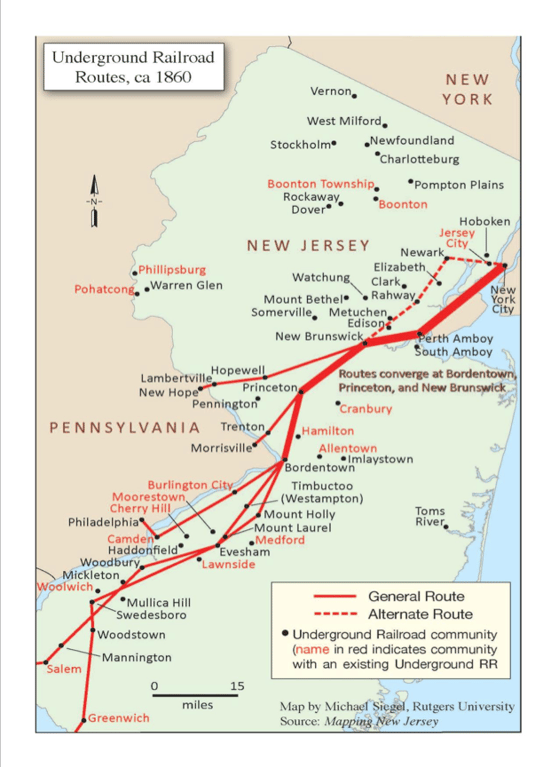
    The Underground Railroad operated primarily during the first half of the 19th century, reaching its peak around 1850.

    Resistance existed as long as slavery existed in the United States. Organizers began gathering in the late 18th century among Quaker communities in Pennsylvania and New Jersey.

    During peak, it is estimated that 1k people per year successfully escaped using the network.

    During the fugitive slave act, the federal law required that even in free states, slaves were captured & returned.

    New Jersey played a critical role in the Underground Railroad due to its geography. Serving as a vital “bridge” between the slave holding states and the South with the safety of New York City and Canada.

    The Greenwich Line crossing was the Delaware Bay, where people landed in Cumberland County or Cape May.

    The Jersey shore provided refuge for those moving toward NYC.

    Committees called Vigilance were the backbone of the movement, providing food, clothing, and legal services.

    Famous conductors include Harriet Tubman (Born in Dorchester County, Maryland), who led 13 trips into Maryland to free enslaved people.

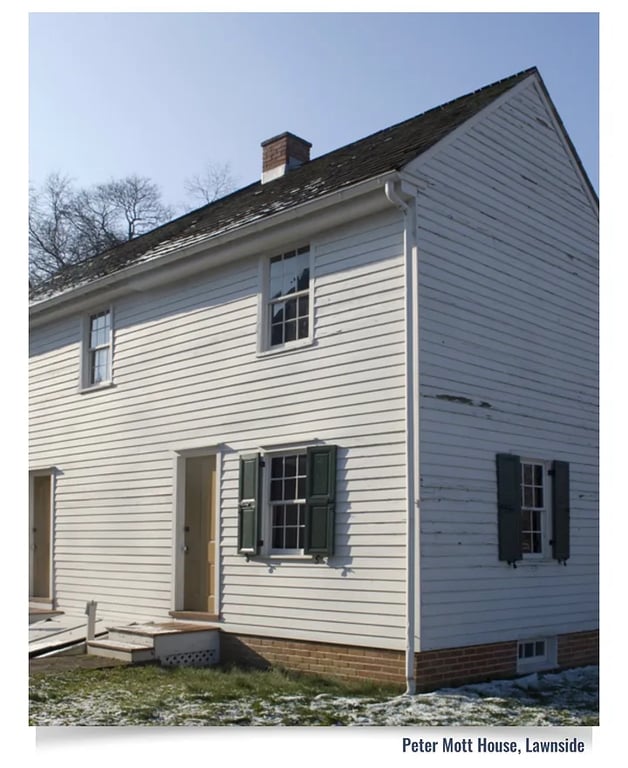
    A lesser-known conductor was Abigail Goodwin, a “Birthright Quaker” committed to abolition so strongly that she was eventually ejected from the Orthodox Quaker Meeting in Salem.

    Some Quakers felt the Underground Railroad was “too radical” or “broke too many laws.” Abigail disagreed, believing human freedom superseded government decree. Famous conductors include Harriet Tubman (Born in Dorchester County, Maryland), who led 13 trips into Maryland to free enslaved people.

    After the war the “Reconstruction” era began from 1865-1877, Black Men saw the right to vote until federal troops withdrew from the south leading to the Jim Crow era a a century of state sanctioned violence which included segregation, disenfranchisement and extrajudicial violence (Lynching, murders, bombings)After the war the “Reconstruction” era began from 1865-1877, Black Men saw the right to vote until federal troops withdrew from the south leading to the Jim Crow era a a century of state sanctioned violence which included segregation, disenfranchisement and extrajudicial violence (Lynching, murders, bombings)

    The foundation of Black History Month began in 1926 as “Negro History Week” in February by historian Carter G. Woodson and the Association for the Study of Negro Life and History.

    Woodson chose February and the second week to be precise because it encompassed the Birthdays of Abraham Lincoln (Feb 12th) and Fredrick Douglass (Feb 14th)

    Two figures celebrated in Black Communities.The foundation of Black History Month began in 1926 as “Negro History Week” in February by historian Carter G. Woodson and the Association for the Study of Negro Life and History.

    Woodson chose February and the second week to be precise because it encompassed the Birthdays of Abraham Lincoln (Feb 12th) and Fredrick Douglass (Feb 14th)

    The following years, before the shift to a month and the recognition nationally in 1976, were superseded by the civil rights movement. A act of resistance which resulted in rebellions fueled by resisters who dignified themselves as humans.

    Thousands of people died.

    Two notable Figures include Ross Parks and Martin Luther King Jr.

    During the 1976 United States Bicentennial, President Gerald Ford officially recognized Black History Month for the first time at a federal level.

    He urged Americans to “seize the opportunity to honor the too-often neglected accomplishments of Black Americans in every area of endeavor throughout history”.

    In 1986, it was codified into law.

    Law 99-244During the 1976 United States Bicentennial, President Gerald Ford officially recognized Black History Month for the first time at a federal level.

    He urged Americans to “seize the opportunity to honor the too-often neglected accomplishments of Black Americans in every area of endeavor throughout history”.

    Since 2026 would mark the 100th anniversary of Carter G. Woodson’s original 1926 version, it is the first time a president has not recognized the month in decades.

    Donald Trump has caused undue harm to the black community by perpetuating stereotypical culture and racism.

    We must all fight to continue this pledge to honor the history of Black People in America and end systemic oppression.

  • New Epstein files link Trump to Mar-a-Lago ‘Calendar Girl’ auctions. 3.5M documents released by DOJ reveal ties to Elon Musk and Jack Lang.

    Grappling with the president’s involvement in the Epstein case

    The Department of Justice released over 3.5 million additional files from the Epstein Files mandated by law. This comes 45 days after they were required to release the documents in a press conference held by Deputy AG Blanche. He states that all photos of women have been redacted, but the DOJ made redaction errors, took files down in real time, and links began expiring. The government partnered with Akamai to deliver the files using a content delivery network. As the files were indexed, President Trump was mentioned over 38,000 times.

    Controversy arose when initial files showed witnesses attesting to “Calendar Girls,” an auction at Maralago, where Trump auctioned off girls measuring their vulva by placing a finger to see tightness. The tip implicates multiple Trump family members, including Elon Musk. In June of 2025, Elon posted on X (Formerly Twitter) stating that the files had not been released because they contained Donald Trump’s material.

    Elon asked to visit Epstein at his New Mexico ranch along at his island.

    Screenshot

    As more digging is happening, the Truth will be uncovered. The victims over the years have participated in interviews, with many committing suicide, under the pressures of surviving horrendous suffering at the hands of convicted sex trafficker Jeffrey Epstein.

    Trump recently has distanced himself from Epstein and has called the files a Democratic hoax. Evidence suggests close ties between Jeffrey Epstein and Donald Trump, with Trump even calling Epstein a terrific guy.

    “I’ve known Jeff for 15 years. Terrific guy,” Mr. Trump told New York magazine in 2002. “He’s a lot of fun to be with. It is even said that he likes beautiful women as much as I do, and many of them are on the younger side.”

    Portrait Jeffrey Epstein (left) and real estate developer Donald Trump as they pose together at the Mar-a-Lago estate, Palm Beach, Florida on February 22, 1997. Davidoff Studios/Getty Images

    George Houraney and his girlfriend attended a dinner with Trump in 1992, during Trump’s first presidential bid in 2016. Houraney participated in an interview and made an assertion that he had to ban Jeffrey Epstein from his events and could not sign on to deals because of Epstein’s conduct. Houraney also goes on to explain the business deals that failed due to Trump’s inappropriate conduct with girlfriend, Jill Harth.

    Donald Trump with Jill Harth in 1992.Credit…George Houraney

    Jan. 24, 1993, Harth and Houraney visited to Trump’s Mar-a-Lago estate in Florida for a contract-signing celebration, At the request of Trump “Calendar girls” were brought along. He offered Harth a tour of the estate and then pulled her into the empty bedroom of his daughter Ivanka. In the FBI tips released in the latest files calendar girls can be attested by multiple sources. Trump has denied this claim.

    Screenshot

    NY Times reporter Nicholas Kristof asked Harth in 2016, “Why would a woman who accused Trump of attempted rape ever go out with him?”

    Harth replied

    “I was scared, thinking, ‘what am I going to do now?’” she says. “When he called me and tried to work on me again, I was thinking maybe I should give this a try, maybe if he’s still working on me, I should give this rich guy a chance.”

    Documents released as part of this new trove of files showed prominent international figures such as Prince Andrew and Jack Lang working with Epstein. Lang began a non-profit, with Epstein spearheading the founding and an initial donation of $75,000. Sylvie Aubry, A long-time friend of Jack Lang and a co-founder of the non-profit, also runs a floral business in France. Jack Lang was previously the minister of Culture, who also states that the non-profit was created to fund a movie. The movie funding was never disclosed. Other Associates of the non-profit, such as the president, treasurer, and secretary, were described as long-term staffers or friends of Lang.

    Bill Gates can be seen in multiple photos with Epstein and world leaders, with some of the pictures of Gates with redacted women discovered during an FBI raid of Epstein’s Island. Recently, in the files, documents state that Gates contracted an STI from Russian girls, but Gates has denied the claims.

    Gates on emails released from files:

    “These claims are absolutely absurd and completely false,” a spokesperson for Gates said in a statement obtained by PEOPLE.

    Further, Gates’s statement states that the files show only Epstein’s frustration at not obtaining a long-term business partnership with Gates.

    Screenshot

    As more information comes out from the files, be sure to check back at this article for updates.