The Pentagon has been the source of news regarding war since 1947, post-WWII. The Pentagon, where the Department of War currently operates, has long granted journalists access throughout military conflicts in which the United States was involved. Now, with Secretary of War Pete Hegseth, the rules have changed. On Friday, March 20th, 2026, a federal judge blocked the restrictions the Pentagon placed on journalists seeking transparency for the world. The Pentagon did not follow the new rules set out. Instead, the Pentagon imposed restrictions on journalists, requiring escorts and the closure of the press wing. The Trump administration has been moving toward a more favorable reporting stance, with right-wing publications having access to the information since the Iran war started. Now, as we are nearly a month into the United States / Israel and Iran war, millions of Americans are asking for answers, but the government is restricting access to information.
Many are calling for the impeachment or resignation of key members of the Trump administration, such as Hegseth, Bondi, and, with Noem losing her position, the American public is one step closer to transparency and core leadership that represents the American interest and the values of the long-standing experiment on democracy in the western hemisphere.
One cool symbol of that relationship was the “Correspondents’ Corridor,” a section of the Pentagon where journalists had desks right next to defense officials. By 2012, people were already saying the corridor was about 40 years old, which would date it to the early 1970s.
That access has always expanded and contracted during conflict, demonstrating the complex relationship between military operations and the media. In the 1991 Gulf War, for example, the military’s use of pools and tightly controlled briefings became a major flashpoint, raising significant questions regarding transparency and information dissemination.
Press-freedom advocates later described the Gulf War as one of the most restrictive modern conflicts for journalists, with the Pentagon channeling information through official briefings and largely limiting independent newsgathering. This careful orchestration of communication was intended to control the narrative and prevent misinformation, yet it ultimately led to widespread criticism from various media organizations and civil liberties groups, who argued that such restrictions undermined the essential role of a free press as a watchdog in a democratic society.
The same battles over access, escort rules, and message control carried into later wars, including Afghanistan and Iraq, where similar restrictions were imposed, often leading to heated debates about the rights of journalists in war zones and the implications for democratic transparency. These debates intensified as technology advanced, enabling citizens to capture and disseminate information instantaneously, thus further complicating the notion of controlled narrative.
The ongoing struggle for journalistic access highlights the tension between national security interests and the public’s right to know, a narrative that continues to evolve with each new conflict, revealing the critical balance that must be struck between safeguarding sensitive information and upholding the foundational principles of democracy. The lawsuit by the New York Times in federal court in Washington, D.C., alleged that the Defense Department’s policy changes last year gave it free rein to freeze out reporters and news outlets for coverage it did not like, in violation of the Constitution’s protections for free speech and due process. The government disputed that characterization and said the policy is reasonable and necessary for national security, arguing that the increasing complexity of modern warfare necessitates such measures to ensure that operational security is not compromised while still attempting to facilitate some level of transparency where possible.
U.S. District Judge Paul Friedman said in his ruling “more important than ever that the public have access to information from a variety of perspectives about what its government is doing”
The memo outlining the changes can be found below:
The Reuters news agency reported on Monday that the Department of Homeland Security (DHS) confirmed it has begun deploying hundreds of Immigration and Customs Enforcement (ICE) agents to assist in security at airports facing significant staffing issues.
ICE agents were deployed at over twelve major travel hubs across the country, with agents seen in Atlanta, San Francisco, New York, and New Jersey. This comes as Donald Trump has threatened further action against everyday working-class people. Posed as a way to expedite lines at airports, ICE agents can be seen patrolling airports rather than processing security lines.
ICE agents are not trained to handle security at airports, unlike the thousands of TSA agents who show up to work every day. With this news to come, many are in fear of targeted harassment across the United States.
The Trump administration is calling for democrats to open the government, which has been holding out in an attempt to restrict funding of DHS. The truth is that Democrats are not the majority; they are not in control to pass legislation allowing the government to fully reopen after a partial shutdown when a funding bill was not passed.
On January 29, 2026, the Senate failed to advance the government funding package in a 45–55 vote. Seven Republicans joined all Democrats in opposing the bill.
Threads / Kevin Ortega-Rojas @hereswhykevinThreads / Kevin Ortega-Rojas @hereswhykevinThreads / Kevin Ortega-Rojas @hereswhykevinThreads / Kevin Ortega-Rojas @hereswhykevin
For nearly a century, the Academy Awards have served as Hollywood’s grand self-portrait. Each year, the global film industry gathers beneath the lights of the Dolby Theatre in Los Angeles to celebrate the achievements of the previous year and crown its winners with cinema’s most famous prize. The Oscars remain one of the most recognisable cultural rituals in entertainment, a night where prestige, performance, and spectacle converge.
At their best, the Academy Awards remind audiences why films matter. They celebrate storytelling, craftsmanship, and the collaborative art that lies behind every frame projected on screen. This year’s ceremony offered those familiar moments of emotion and theatre that have defined the Oscars for generations. Emotional speeches, unexpected wins, and the occasional flash of genuine humility all played their part.
Yet beneath the glamour, the Oscars also reveal something else about Hollywood. They show the industry’s contradictions.
For years, the Academy has struggled with an image problem. Television ratings have fallen, and audiences have grown increasingly sceptical of a ceremony that often feels disconnected from the people who watch the films it celebrates. While the awards still carry enormous prestige within the industry, the cultural authority of the Oscars is no longer unquestioned outside Hollywood.
One of the most visible flashpoints came during the “Oscars So White” controversy, which erupted in 2015 when all twenty acting nominees were white for the second consecutive year. The hashtag quickly grew into a wider conversation about systemic racism and representation in Hollywood casting and award recognition. Those concerns were legitimate and long overdue. For decades, the industry had struggled with meaningful inclusion, particularly regarding roles, opportunities, and recognition for minority performers.
But the debate was not without its own contradictions. Some of the loudest voices calling for reform came from figures within the same privileged industry structure they were criticising. Actor Will Smith was among those who publicly criticised the Academy’s lack of diversity and announced a boycott of the ceremony.
The irony was difficult to ignore. Smith himself had already been nominated for Academy Awards twice during his career, and on both occasions he lost to other Black actors. The controversy highlighted a deeper problem in Hollywood’s culture of public advocacy. Genuine structural issues were sometimes entangled with personal grievances and industry politics.
This dynamic is part of what fuels the public perception that the Oscars can feel self-congratulatory. Hollywood is often eager to celebrate its own moral awareness, yet less comfortable confronting the structural realities of the system that produces it. When actors deliver speeches about social justice from one of the most exclusive stages in entertainment, audiences sometimes hear sincerity. At other times, they hear a lecture from people whose lives are far removed from those watching at home.
The Academy has taken steps to address these criticisms. Membership has expanded significantly in the past decade, bringing in more international voters and a more diverse professional base. In theory, this broadening of the voting body should create a more representative awards system and reflect the increasingly global nature of filmmaking.
A recent rule change has also addressed one of the Oscars’ long-standing open secrets. Voters must now confirm that they have actually watched the nominated films before casting their ballots. For years, it was widely acknowledged within the industry that some voters based their decisions on reputation, studio campaigns, or partial viewing rather than the films themselves.
Requiring voters to watch the nominated work may sound like an obvious standard, but its impact is potentially significant. Smaller films and less aggressively marketed productions now have a better chance of competing against studio campaigns backed by massive advertising budgets. In theory, it gives a fairer hearing to the many craftspeople and independent creators whose work might otherwise be overshadowed by prestige marketing.
But the Academy’s attempts at reform continue to raise questions about priorities.
In 2024, the Academy announced a new competitive category for Best Casting, which debuted at this year’s ceremony. While casting directors play a vital role in filmmaking, the decision puzzled many observers. Poor or uninspired casting has become one of the most common complaints among modern audiences, particularly when studios adapt beloved intellectual properties or franchise material.
In that context, the decision to create a casting award felt strangely misaligned with audience concerns. If the Academy truly wished to recognise overlooked parts of filmmaking, many critics argue that a far more obvious addition has existed for decades.
Stunt performers.
From high-speed car chases to physically demanding fight choreography, stunt work has defined some of cinema’s most memorable moments. Yet despite the skill, training, and risk involved, stunt performers remain entirely absent from the Oscars. The omission is especially striking when compared with other awards ceremonies. The Screen Actors Guild has recognised stunt ensembles for years, and audiences regularly celebrate stunt professionals as central figures in action filmmaking.
Unlike many areas of the film industry, stunt work is also often rooted in working-class labour. These performers risk injury to create the illusion of danger that defines modern blockbuster cinema. Their absence from Hollywood’s most prestigious awards has long been viewed as one of the Academy’s most glaring oversights.
The contrast between recognising casting while continuing to ignore stunt performers highlights a broader issue. The Oscars have historically favoured certain forms of artistic labour while overlooking others. Cinematographers, composers, and editors rightly receive recognition, but many of the physical and technical crafts that shape filmmaking remain outside the Academy’s spotlight.
The industry now faces an even more complicated challenge as artificial intelligence begins to reshape the landscape of creative work.
AI technology is already capable of replicating voices, generating visual effects, and producing script-like text. While some filmmakers see the technology as a tool that could enhance production, others view it as a direct threat to creative labour. During recent Hollywood labour disputes, writers and actors voiced serious concerns that studios could use AI to replicate performances or generate content without fair compensation.
The implications are profound. Cinema has always evolved alongside technology, from sound to colour to digital effects. But AI raises deeper questions about authorship and artistic ownership. If performances can be digitally reproduced or scripts partially generated by machines, what exactly counts as creative work?
The Academy cannot avoid that debate. As the symbolic guardian of cinematic excellence, the Oscars have commented on AI through jokes and skits, but a serious denunciation has yet to occur.
AI is a threat to workers’ rights, art, and the environment, and the Academy needs to hold the studios wanting to use it to account. Disney has shown to be hypocritical in this regard, announcing that they intend to use generative AI in their filmmaking while seeking legal action against AI generators who use Disney-licensed material.
Hollywood’s most prestigious awards ceremony has never been entirely free from controversy, and few scandals have cast a longer shadow over the Academy Awards than those involving sexual abuse and misconduct within the film industry itself. Two names in particular, Harvey Weinstein and Roman Polanski, have become emblematic of the tensions between artistic prestige and moral accountability.
For decades, Harvey Weinstein was one of the most powerful figures in Hollywood. As co-founder of Miramax and later of The Weinstein Company, he became notorious for aggressive Oscar campaigns that helped shape modern awards-season strategy. Films such as Shakespeare in Love, The King’s Speech, and Chicago all benefited from Weinstein’s relentless lobbying of Academy voters. Yet behind the scenes, Weinstein’s power masked years of horrific abuse. In 2017, investigative reporting revealed a pattern of sexual harassment, assault, and coercion spanning decades. The revelations triggered the wider #MeToo movement, forcing Hollywood to confront the culture of silence that had allowed such behaviour to persist. Weinstein was expelled from the Academy shortly afterwards and later convicted of rape and sexual assault in court, but that was somehow even more damning as the Academy, and the industry in general, had enabled Weinstein’s abuse for decades.
The case of Roman Polanski presents a different but equally troubling chapter in the Academy’s history. Polanski fled the United States in 1978 after pleading guilty to unlawful sexual intercourse with a minor. Despite this, he continued to work internationally and remained a celebrated director for decades. In 2003, he won the Academy Award for Best Director for The Pianist. Polanski did not attend the ceremony due to his fugitive status, but the moment nevertheless highlighted the Academy’s hypocritical relationship with its own values. For years, he remained a member of the organisation, only being expelled in 2018 after renewed pressure following the Weinstein scandal.
Together, these cases illustrate the uncomfortable truth that Hollywood’s culture of prestige has often coexisted with a reluctance to hold powerful figures accountable. The Academy’s responses have evolved over time, but the legacy of these scandals continues to shape how audiences view the institution today. It makes the moral grandstanding and lecturing for Hollywood’s elite all the more unpalatable.
Despite the criticisms and scandals, the Oscars remain a powerful institution. Winning an Academy Award can transform careers, elevate independent films, and introduce audiences to voices they might otherwise never encounter. The ceremony still serves as one of the few global stages dedicated entirely to celebrating cinema as an art form.
But prestige alone is not enough to sustain credibility.
For the Oscars to remain meaningful in the modern era, the Academy must continue to evolve. Recognising stunt performers would acknowledge one of the industry’s most overlooked crafts. Expanding transparency in voting and membership could rebuild trust in the awards process. Confronting the implications of AI would demonstrate that Hollywood understands the future of its own medium.
Most importantly, the Academy needs to lead the industry in holding power to account. It can no longer sit idle while thinking that a skit or joke on a safe stage is enough. Award winners need to do more than make meaningless statements in sugary speeches. Actions speak louder than words.
The Academy Awards were created to celebrate the best of filmmaking. The challenge now is to ensure that the celebration reflects the full reality of the industry behind the scenes.
Hollywood loves stories about reinvention. If the Oscars wish to remain the ultimate symbol of cinematic achievement, they may need to embrace one themselves.
Carr is the American lawyer who leads the Federal Communications Commission, or FCC. The FCC oversees multiple aspects of American infrastructure related to broadcasting and communication. The router in your home is required to be approved by the FCC, and even the broadcast television you see, which is the old style of TV with an antenna, not cable or streaming. You may have listened to a radio station overseen by the FCC, and even the fiber-optic communication lines across the seafloor are overseen by the FCC. The FCC has a stake in almost all ways news is disseminated. They do not have a say in an independent journalist like The Penny Tribune.
On social media, Carr Stated,
X /
Carr’s September 2025 assault on Jimmy Kimmel was not just another culture-war flare-up. It was a revealing snapshot of how regulatory power can be repurposed into political intimidation. After Kimmel made remarks about the assassination of conservative activist Charlie Kirk, Carr condemned them as “some of the sickest conduct possible” and openly suggested there was a “path forward for suspension.” The consequences came fast: ABC suspended the show indefinitely, while Nexstar and Sinclair pulled it from their stations. Kimmel returned less than a week later, but by then the point had already been made. The threat had landed.
What mattered most was not just Carr’s outrage, but the mechanism behind it. He warned broadcasters that continuing to air the program could expose them to “fines or license revocation from the FCC,” then delivered the kind of line that sounds less like public service and more like a political enforcer flexing state power: “We can do this the easy way or the hard way.”
And that is the real story. Because this did not emerge in a vacuum. Carr has increasingly built a public record that suggests a willingness to blur the line between communications oversight and ideological punishment. The Kimmel episode did not feel aberrational. It felt consistent. Another moment in a broader pattern where the language of regulation is used not simply to govern the public airwaves, but to pressure media institutions, shape editorial behavior, and send a message about who can speak freely without consequence.
That is what makes this bigger than late-night television. When a federal regulator begins sounding less like an independent steward of the public interest and more like a partisan actor willing to weaponize licensing authority, the danger is not just censorship in the formal sense. It is the creation of a climate where media companies begin disciplining themselves before the government ever has to. Fear does the work. Compliance follows. And the public is left calling it oversight when it looks a lot more like coercion.
When Brenden Carr threatened media companies, he was threatening the public to restrict access to information. The threat began with the reporting of the Iran war started by the Trump administration nearly three weeks ago, on February 28th 2026 by media companies that Trump has deemed to be in opposition after the American airstrike of a girls’ school, killing over one hundred and fifty people.
Supporting indepenedent journalism is the right path forward in this instance. The Penny Tribune has no agency to get permission from, we are the press, we will share the truth unfiltered and indicitaive of the stkes of a ever changing corrupt government with facist ideology.
On March 11, 2026, Gavin Newsom publicly addressed reports about a alledged Iran-linked drone threat and said, “As it relates to drone strikes, we have been aware of that information.” KCRA reported this as remarks he made on Wednesday while discussing California security coordination through the State Operations Center and Cal OES.
On Facebook Newsom alerted:
I am in constant coordination with security and intelligence officials, including with California Governor’s Office of Emergency Services, to monitor potential threats to California — including those tied to the conflict in the Middle East.
While we are not aware of any imminent threats at this time, we remain prepared for any emergency in our state.
The video was verified with the Govenrors press office
California is home to over 39.5 million people with a large coastal area stretching over 800 miles. Iran is 7,300 miles in distance from California. Iran’s longest-range documented ballistic missiles include the Khorramshahr-4, also known as the Kheibar, as well as other missiles in the Khorramshahr family. Publicly reported estimates place their operational range between roughly 2,000 and 3,000 kilometers. These are liquid-fueled systems designed to carry heavier warheads, and they have drawn particular attention for their reported ability to reduce detection and complicate interception. (Iran Watch)
Senator Alex Padilla,
“My office is aware of reports of potential Iranian retaliatory attacks on California communities and I remain in contact with local and state partners to ensure public safety. I’ve also requested additional information from Trump administration officials on federal efforts to counter any potential threats.”
Aetna Inc., a national health insurer incorporated in Pennsylvania, has agreed to pay $117.7 million to resolve allegations that it violated the False Claims Act by submitting — or failing to correct — inaccurate diagnosis codes for patients enrolled in its Medicare Advantage plans. According to federal investigators, those inaccurate codes resulted in inflated payments from Medicare.
On its face, the settlement reads like another corporate compliance case. A large insurer, a large payout, a set of allegations resolved without an admission of wrongdoing. But beneath the legal language sits a far more uncomfortable question about the structure of the American healthcare system itself: what happens when private corporations are paid billions of taxpayer dollars to care for the nation’s elderly, while simultaneously being rewarded by investors for maximizing revenue and reducing costs?
By Kenneth C. Zirkel – Own work, CC BY 4.0, Aetna Insurance building, Hartford, Connecticut
The Aetna case offers a window into that tension.
Medicare Advantage, also known as Medicare Part C, allows seniors to enroll in private insurance plans instead of traditional government-run Medicare. These plans are run by private insurers known as Medicare Advantage Organizations.
Under the program, the Centers for Medicare and Medicaid Services pays insurers a fixed monthly amount for each enrollee. That payment increases depending on how sick a patient is expected to be. The more serious the diagnoses attached to a patient’s file, the higher the payment the insurer receives.
To calculate those payments, insurers submit diagnosis codes to the government documenting the medical conditions of their patients.
Federal officials say Aetna submitted inaccurate or unsupported diagnosis codes that increased those payments. Investigators also say the company failed to withdraw certain codes after they were found to be unsupported and falsely certified that the data submitted to regulators was accurate.
The settlement resolves those allegations.
“The government pays private insurers over $530 billion each year to care for Americans enrolled in Medicare Advantage,” said Assistant Attorney General Brett A. Shumate of the Justice Department’s Civil Division. “We will continue to hold accountable insurers that knowingly submit inaccurate or unsupported diagnoses to improperly inflate reimbursement.”
Investigators say part of the issue traces back to a chart review program Aetna used in 2015. The program paid coders to review patient records and identify conditions supported by medical documentation.
According to federal officials, Aetna used those reviews to add new diagnosis codes, thereby increasing the payments it received from Medicare.
But when those same reviews suggested that previously submitted diagnoses were unsupported, investigators say the company did not remove them — a step that would have required the insurer to repay the government.
In effect, prosecutors argue the program allowed the company to identify opportunities for additional payments while ignoring evidence that it may have already been overpaid.
The settlement also resolves allegations spanning 2018 through 2023 involving diagnosis codes related to morbid obesity.
Morbid obesity diagnoses are typically supported by Body Mass Index measurements documented in patient records. Federal investigators say some of the codes submitted by Aetna were inconsistent with BMI data in those records, resulting in increased Medicare payments.
Part of the case arose from a lawsuit filed by a former Aetna risk-adjustment coding auditor under the False Claims Act’s whistleblower provisions. Those provisions allow private individuals to sue on behalf of the government when they believe fraudulent claims have been submitted for federal funds.
The whistleblower in the case, Mary Melette Thomas, will receive $2,012,500 as part of the settlement.
While the agreement resolves these allegations, Aetna’s legal history reflects a broader pattern that has followed the private insurance industry for decades.
The company, now owned by CVS Health following a massive merger in 2018, has previously faced lawsuits and investigations related to physician reimbursement, billing practices, and claim denials. In the early 2000s, Aetna paid hundreds of millions of dollars to settle class-action lawsuits brought by doctors who accused the insurer of systematically underpaying medical providers.
Patient advocates have also raised concerns about the growing use of automated claim review systems and complex billing processes that can result in delayed or denied care.
For many Americans, those disputes are not abstract policy debates. They are decisions that can shape whether a patient receives treatment.
One of the most widely cited cases involved Nataline Sarkisyan, a 17-year-old leukemia patient in California whose doctors recommended an emergency liver transplant in 2007. Her insurer initially denied coverage for the procedure, calling it experimental. After intense public protests and national media attention, the company reversed its decision. Sarkisyan died hours later before the transplant could take place.
Stories like that have helped fuel a growing frustration among patients navigating the American healthcare system.
Even when people have insurance, the path to receiving care can involve prior authorization requirements, coverage disputes, and complex billing rules that many patients struggle to understand.
At the same time, healthcare costs continue to climb.
In 2024, healthcare spending in the United States reached approximately $5.3 trillion, accounting for roughly 18 percent of the country’s entire economy.
Insurance premiums have also surged. The average annual premium for family coverage reached nearly $27,000 in 2025, with workers paying thousands of dollars of that cost themselves.
Since 2015, family premiums have increased by more than 50 percent.
Prescription drugs add another layer of pressure. Americans spend more than $600 billion each year on medications, and surveys show nearly one in four patients struggles to afford their prescriptions.
Yet the challenges facing the system extend beyond cost alone.
Across the country, hospitals are grappling with staffing shortages, rising operating costs, and the financial strain of caring for aging populations. In rural communities, dozens of hospitals have closed or scaled back services in recent years, leaving many patients with fewer options for care.
Meanwhile, Medicare Advantage itself has become a financial powerhouse on Wall Street.
Today, more than half of all Medicare beneficiaries are enrolled in Medicare Advantage plans, and the program represents one of the most profitable segments of the private insurance industry. Investors closely watch enrollment growth, reimbursement rates, and risk-adjustment payments because they directly influence the revenues of companies like UnitedHealth, Humana, and CVS Health.
That dynamic creates a difficult reality at the heart of the system: the same program designed to care for aging Americans has also become a major revenue stream for publicly traded corporations whose primary legal obligation is to deliver returns for shareholders.
Cases like the Aetna settlement sit at the intersection of those two realities.
Supporters of private insurance argue that companies help control costs and coordinate care within a complex healthcare system.
Critics say the incentives embedded in that system encourage insurers to push diagnoses upward when billing the government while pushing payments downward when covering patient care.
The result, for many Americans, is a system that often feels impossible to navigate.
Coverage may exist on paper. But access to timely, affordable care can still depend on whether a treatment is approved, whether a provider is in network, or whether a claim is denied.
The Aetna settlement will return more than $117 million to the federal government. But the deeper issue it exposes is not simply about one insurer or one case.
It is about a healthcare system that now consumes nearly one-fifth of the American economy while leaving millions of patients struggling to afford care, find doctors, or understand the rules governing their own insurance.
When a comment was requested from Aetna, they responded with:
“Aetna continues to disagree with the DOJ’s industry-wide allegations, and this settlement should not be seen as an acknowledgment of liability. Instead, we are now able to avoid the uncertainty and further expense of prolonged litigation, as we maintain our focus on delivering first-in-class member experience across our Medicare Advantage plans.” Phillip Blando, Aetna Spokesperson.
In 2025, Aetna generated $2.9 billion dollars of profit.
At some point, the question stops being whether one company misreported diagnosis codes.
The real question becomes whether the structure of the system itself is working — or whether the country has built a healthcare economy so financially complex that accountability arrives only after billions have already been spent.
For millions of Americans trying to navigate illness, insurance, and rising costs, that question is no longer theoretical.
Many people underestimate the power of music. Melodies that raise the hairs on your arms. Beats that sync up with your heart. Words that feel like they could have come from your own brain. Music is made with the intention to make you feel something. Whether it be the pain the musician is going through, the joy they’re experiencing, or the hope they are trying to inspire, they want to stir the listener’s emotions, hoping you feel the way they felt while creating their masterpiece.
For times of resistance, there is protest music. These compositions are made to keep you going, even when it feels like the fight is impossible. That music is made to help you feel less alone in your fight; to let you know that there are others in this journey with you. When everything around you feels like it’s falling apart and no one is noticing, resistance songs are there to let you know that you aren’t crazy.
Protest music and resistance songs aren’t new. In fact, they’ve been around for centuries. In 1774, Dr. Joseph Warren wrote “Free Americay”, a popular song for the American Revolution against British tyranny. “Woodman, Spare That Tree!” by Henry Russell in 1837 was one of the first songs used to help advocate for environmentalism. The Hutchinson Family Singers created “Get Off The Track!”, a ballad that called for emancipation in 1844. A Pro-Suffrage song named “The Suffrage Flag” was written in 1884 by William. P. Atkinson proclaimed how much better the world would be when women were granted the right to vote (which wouldn’t happen for another 3 decades). Joe Hill, a labor activist, wrote “The Preacher and the Slave” in 1911 as a condemnation of the Salvation Army. There were songs that helped enslaved people find their way to freedom. Songs to reconnect those kidnapped people with the cultures they were robbed of, or deal with the grief of the family members they lost. These few songs are just a fraction of the protest music that emerged in the centuries leading up to the 21st, and every single one of them was important in its time. Some are still pertinent to the world we live in. (source)
Cover depicts a gentleman talking to a farmer holding an axe underneath a large tree. The farmer’s house and water well are visible. Russell, Henry, 1812-1900 (Composer) Morris, George P. (Lyricist)
Songs of resistance are still being made today. Music that tackles issues like women’s rights, healthcare reformation, and pushing back against harmful governments is alive and well in 2026. The main problem is that the musicians who create them are often overlooked in favor of popular mainstream artists whose only goal is to make another hit. Many radio stations stick to the fun songs, the dance tracks, the ballads about ex-lovers; anything that is deemed safe for the general population and won’t rock the boat with the people in charge.
Luckily, we no longer need to rely on radio stations that handpick the “more palatable” songs in an effort to keep us under a false sense of security or placate the conservative powers-that-be. We live in a modern age where we can discover new music from around the world and create our own playlists that reflect how we actually feel. Here are 5 songs for you to add to your modern resistance collection.
“Labour” by Paris Paloma
Hard hitting lyrics:
“All day, every day, therapist, mother, maid
 Nymph, then a virgin, nurse, then a servant
Just an appendage, live to attend him
So that he never lifts a finger
 24/7 baby machine
So he can live out his picket-fence dreams
It's not an act of love if you make her
You make me do too much labour”
“Take My Country Back” by Enter Shikari
Hard hitting lyrics:
“Get up, get up and feel the rising tide
I’m fed up, fed up with all the cyanide.
Don’t want to take my country back
I want to take my country forward”
“Dead Men Don’t Rape” by Delilah Bon
Hard hitting lyrics:
“They get so offended when I say
Dead men don't rape
But where is their anger when I say
Women are women are women are dying”
“THREAT LEVEL ORANGE” by Earth to Eve Hard hitting lyrics: “Ain't it obvious The person in the office is A racist Bride came in the mail, but he opposes immigration That's someone's abuelita Not a foreign armed invasion That would be the masked men raiding graduation ceremonies Unmarked vans snatching people off the street Broke amendments5, 10 and 14 At least But please, tell me again how this is still democracy”
“G-U-I-L-L-O-T-I-N-E” by HummusVacuum
Hard hitting lyrics:
“G-u-i-l-l-o-t-i-n-e
Yeah, what might seem barbaric is a last resort to me
‘Cus we waited for our crumbs to trickle down so patiently
And now we get to cosplay like it's 1933”
Protest music hasn’t gone anywhere. Sometimes you just need to search a little harder to find it. When you do, let the beat lead your steps. Let the words give you the courage to continue the fight. Let the songs of resistance deliver the message that you, and we, are not alone in this revolution.
March 10, 2026 – Governor Sherrill delivered comprehensive remarks today outlining the state’s proposed budget for the upcoming fiscal year, emphasizing investments in education, infrastructure, and healthcare while maintaining fiscal responsibility.
Speaking from the State Capitol, Governor Sherrill presented a $45.2 billion budget proposal that reflects a 3.8% increase from the previous year. The Governor stressed that this budget represents “a balanced approach to meeting our state’s growing needs while ensuring long-term financial stability.”
The largest portion of the budget increase will be directed toward education, with $2.1 billion in new funding allocated for K-12 schools and higher education institutions. “Our children deserve world-class educational opportunities,” Sherrill stated, announcing plans to increase teacher salaries by 5% and expand access to early childhood education programs.
Governor Sherrill announced a $1.5 billion infrastructure package aimed at repairing aging roads, bridges, and public transit systems. The plan includes funding for sustainable transportation projects and electric vehicle charging stations across the state.
The budget allocates $800 million to expand healthcare access, including mental health services and substance abuse treatment programs. “Healthcare is a fundamental right, and this budget reflects our commitment to ensuring all residents have access to quality care,” the Governor emphasized.
Despite the increased spending, Governor Sherrill highlighted several cost-saving measures, including government efficiency initiatives expected to save $300 million annually. The budget maintains the state’s rainy day fund at 8% of total expenditures, exceeding recommended levels.
Next Steps
The proposed budget will now move to the state legislature for review and approval. Legislative leaders from both parties have indicated they will begin hearings next week, with a final vote expected by May 1st.
“This budget represents our vision for a stronger, more prosperous state,” Governor Sherrill concluded.”
Governor Rebecca Michelle “Mikie” Sherrill is the 57th Governor of New Jersey. Sworn in on January 20, 2026, she is the first Democratic woman to hold the office and only the second woman in the state’s history to serve as governor.
In early 2026, immigration enforcement in the United States had expanded significantly, with increased funding and a shift toward conducting “at-large” arrests in communities. This expansion has resulted in unprecedented detention figures and increased fear among immigrant populations.
Current ICE Statistics (2025–2026)
Since the start of 2025, ICE operations have significantly increased under the current administration’s mass deportation efforts:
– Detention Surge: By January 25, 2026, ICE detained 70,766 individuals, a record high and 75% more than the previous year.
– Arrest Patterns: In 2025, ICE made about 240,000 arrests, more than doubling the 2024 figure, with a 600% rise in “at-large” arrests in communities.
– Criminal Records: Despite claiming to target “criminal illegal aliens,” data shows 74.2% of detainees have no criminal convictions. Non-citizen immigrants make up only 14% of the population.
– Fatalities: 2025 was the deadliest year for ICE detention, with 32 deaths. By mid-February 2026, there have been 6 deaths and 2 fatal shootings by agents.
– Funding: The “One Big Beautiful Bill Act” of 2025 allocated $45 billion for detention expansion, enabling ICE to operate up to 135,000 detention beds through 2029.
All across the country, people are standing up and voicing their anger toward the Trump Admin. Change is the point of voice, and independent journalists have a duty to share the stories of those who show up and stand out. Now is the time to voice and protest. Millions of working-class people are struggling to make ends meet and are one financial crisis away from collapse, yet the Trump administration has promised financial stability for families.
Trump, during his campaign, promised he would remove violent crime offenders from the communities, but many knew this was a dogwhistle of racism toward black and brown people. Many families are in fear, and the government is attacking the sanctity of American freedom.
Diana L. Adams-Wendler (Protester)Diana L. Adams-Wendler (Protester)Diana L. Adams-Wendler (Protester)
This episode is about the foundations of community action and fighting for the equality of all neighbors.
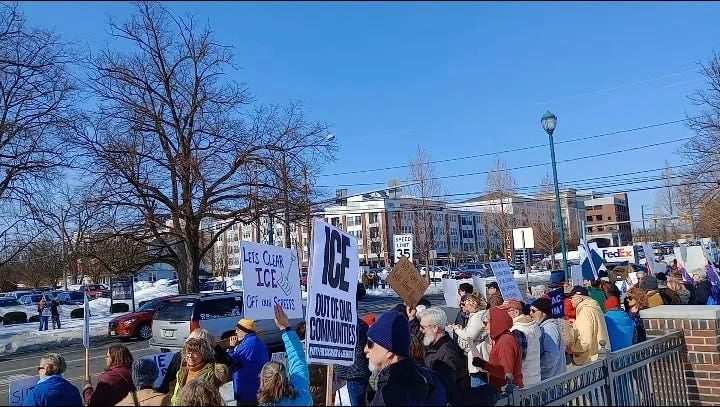
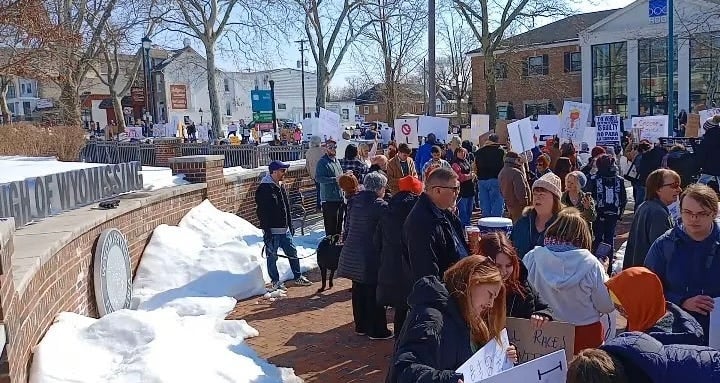
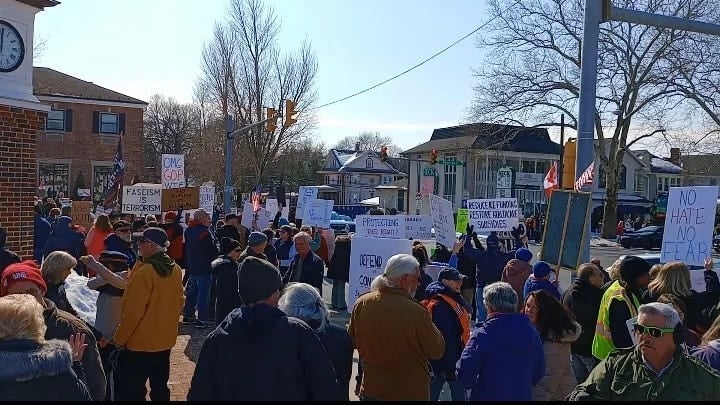
Penelope explores the opinions and righteous voice of Marra, a first-time protestor from Sparta, NJ, who contributed to the Ledgewood Ice protest, which attracted over 300 people from not only Ledgewood but the greater community, fighting to avoid the construction of a five-hundred-thousand-square-foot ICE facility that the federal government is attempting to implement in Roxbury, NJ.
Marra, Summit NJ Resident, First Time Protester
Marra – Ledgewood, NJ, Protestor, working-class perspective, an audio history of events transpiring for active change in New Jersey, transcribed.
Here is the transcript of the Penny Pointed Podcast between Penelope and Marra:
Podcast Transcript
Penelope: Thank you for tuning in. You’re listening to the Penny Tribune, Penny Pointed Podcast, a podcast about holding politicians accountable, exposing corruption, and sharing the stories and perspectives of working-class people and families. Today, we’re covering topics about ICE raids and protests happening across the state. My name is Penelope. I’m here with Marra, who attended the Ledgewood protest, and we’re going to talk about the outcomes and opinions and what to do in situations like this. So, Marra, thank you so much for giving me your time today. And first, I wanted to start with where you’re located, how you found the protest, and what has been your journey politically with activism.
Marra: Sure, no problem. Thank you for checking in. I’m actually a resident of Sparta, New Jersey, so I live in Sussex County, which is very well known as a red county. And I found the protest through Sussex Visibility Brigade, which my friend introduced to me, actually, pretty recently. I would say that I haven’t really been looking too far into where I can find such activism in our county because, again, it’s red. But when I saw this protest, this was actually my first protest I ever went to. So this is like a new thing for me to really start stepping out of my comfort zone and showing up and speaking up more just because of what we’ve seen in the last year in our country and with what this protest in Ledgewood was for, protesting against the potential sale of a warehouse in Roxbury that would become a detention center for ICE and what that would do to northern New Jersey, not just the town of Roxbury, but all of the neighboring towns in New Jersey. I just felt like I needed to be there. I needed to see other like-minded people outside with me, so I didn’t feel so alone in my fears about what’s been going on.
Penelope: Yeah, that’s understandable right now. There’s so much uncertainty, and I mean, I’m sure you saw everything in Minneapolis with Operation Metro Surge, and in New Jersey, ICE activity is picking up like extremely rapidly, and we’ve already had a shooting in New Jersey. Yeah, so things are escalating, and so many people are scared like you, and so many people are just frightened about what’s going to happen and angry, like rightfully so. And so, did you always live in Sparta? Growing up, what were your views on immigration and political policies? Like, how did you develop into these viewpoints to understand, like, social justice and getting involved?
Marra: So I grew up in Sussex County. I’m originally from Vernon. My husband is originally from Vernon, and we moved to Sparta once we got married. You know, I don’t know. I feel like growing up in Sussex County, there was this bubble, and I think it also depended upon how you were raised. I wouldn’t say that I wasn’t aware of how problematic our county and our country could be, but I definitely will admit to my privilege and my ignorance for a very long time. I’m fine with saying that. I think it’s honesty. But I do feel like I was always someone who couldn’t understand why people were so cruel and why racism was still so prominent. I went to college in New York City. I went to a technical school where people from every part of the world came. You know, it was a big LGBTQIA school. I was just immersed around people and just nothing any of them can do, whether you’re black, you’re brown, you’re gay, you’re bi, or trans, I don’t understand how people are so offended and can be so cruel. And I just think seeing it more now, seeing an administration that’s governing our country and using such vile language and speech against such large communities and taking all of the racism that’s been under the surface and letting it boil to the top and letting it be almost okay is just, it’s abhorrent and I guess I’m just at this point where the anger is, I can’t fully contain it anymore and it’s just being around so many people whose heads are down, they don’t want to disrupt status quo. It’s taken a lot of me looking inside myself, distancing from family and friends. So like I think there was always a little bit of the angry person in me wanting to fight back against people hurting other people and I just now is the time that it calls for more of us to stand up.
Penelope: Would you say everyday people and us being part of the working class, like what would you say our duty is to stand up and with the non-citizen population being less than 14% of violent crime or criminal offenders and Donald Trump’s admin saying that they’re only going after criminals, but now we see just like families being torn apart like what happened in Lindenwold where ICE decided to visit a bus stop for fourth and fifth graders and families were running, parents were alerting their neighbors? And how do you think this is all affecting, like, families and just the outright propaganda and fascism that’s happening right now?
Marra: I would hope that families, especially in my area, who I feel generally don’t talk about anything, are starting to wake up more to it. And look to just what was happening in Minnesota the last two months to see the damage that is being done. I mean, everything is being recorded. I cannot understand how people can look away from a video of a mother holding a baby as their dad is being dragged off. You know, I just it’s crazy to me and I would hope that I would hope that I could have more space in feel talking to coworkers or friends of friends to just say you need to take a look around you, like this could be anyone and everyone in your community and it’s affecting all of us because of the way that they’re being treated and the violent way with which they’re being kidnapped off of the street. It directly impacts all of us.
Penelope: When you were at the protest, what was the atmosphere like? Did you talk to anyone? What were the key points that were addressed?
Marra: So being my first protest, a little nervous, wasn’t sure what to expect. I actually thought it was going to be a smaller protest based off of just looking at the ad on Instagram, seeing that there weren’t a lot of likes. But showing up there, I went with two friends, and we got there, and it was larger than I thought it was going to be, and it was peaceful, and everyone was friendly. Everyone was, you know, willing to talk about their fears about what this if the sale of the warehouse could go through could mean. There were about four speakers. They were either from a union or a councilperson. One was a councilperson from Sparta who spoke on behalf of himself, not for Sparta Township. And they just rolled out the facts about what this could mean for Roxbury and the neighboring towns from an environmental standpoint, from a financial standpoint, you know, moral and ethics aside. So I think that was really important for them to reiterate that point of why we went there on Monday for the protest. And you know, like there was for every one car that drove by flipping us off or yelling bad words at us, there were ten more cars honking in support and that felt to me like that I just it gave me some hope we’re not alone. People that feel afraid and angered and worried and concerned that there are groups of us that are feeling it together and I think just showing up on Monday probably maybe 300 people, I don’t know exactly. I think seeing that number was was really great.
Penelope: How do you think protests like this inspire change in communities to take action?
Marra: I think the more people that show up and the bigger the protests are, I think this woman standing next to me on Monday, she had made a comment that sometimes like she feels that maybe protests don’t always work, but at least showing up in numbers it shows the people that we’re paying to govern us and pass our laws, it shows them that we’re watching them and that we see them. We’re like the checks and balances for them. So I think the more people that can make time to do protests or you know find other avenues of activism, I know Sussex Visibility Brigade, they were doing like a craft night where it was assembling whistles and things like that. Doing those small things and getting larger numbers to do them shows that we’re watching government and we’re looking for change.
Penelope: What changes do you think need to happen and how can you inspire your community members to make those changes?
Marra: Changes… a lot. I mean I guess when I’m looking at Sussex County, it’s still very antiquated in old thinking up here. I think a younger generation will push for more progressive thinking and I already see it with my friend’s kids, my nieces and nephews, they’re whole more accepting of everyone and I think we need to get I think we need to get younger people in leadership roles. They bring fresh perspective. I think they have, you know, a more open view of the world and I would hope that now that I’ve attended one protest that I could attend more and become more active, maybe with Sussex Visibility Brigade, and just step up more. I know it’s holding myself accountable and stepping up more.
Penelope: Awesome. Yeah. What do you think independent journalists like me, what is our responsibility to like show up for communities and tell the stories of what’s happening?
Marra: I think independent journalists like you are more important now than ever just based off of how much information we’re not getting from bigger journalists because their information is getting suppressed. I think it’s important that independent journalists remain open and honest, do their due diligence with research and you know show up for the people because I feel like bigger news now, I can’t I you can’t rely on them for it. And I came across you on Threads, seeing that you’re from New Jersey, seeing that you’re reporting what’s happening locally around us. You know, I’m not going to get that from a big news channel. I only get it from independent people.
Penelope: Yeah, yeah, that’s journalism is under attack right now by the Trump admin and it’s such a scary place to be but it’s definitely worth it to make sure truth is out and do you think the politicians in New Jersey are actually representing the people like Corey Booker and Governor Cheryl?
Marra: I’m wary. I’m not feeling great about Booker right now. I feel like I’m seeing that a lot. It just feels like he’s become very performative and I don’t know when that actually changed. My hope is that Governor Cheryl will be a good governor. I do like that she’s already been proactive as far as some of the executive orders and initiatives she’s taken with ICE in New Jersey. Can only hope for the best. But yeah, I there are some New Jersey reps that I am a little bit worried as far as where they really stand and I think Corey Booker is the biggest one because he’s been around for so long. I sometimes think that maybe and I voted for him a few times so I think that I don’t know is it that you get to a certain point and you’ve exhausted your seat and it’s time to let somebody else step up? I think there’s a lot of questions he needs to answer. I don’t know if he’s doing that because he’s on a book tour. But I think that people of New Jersey want answers. I know we’re a blue state but we have a lot of red areas and we just need we just we just need answers.
Penelope: Yeah. What are some small changes communities can do to protect the non-citizen population and what has been your personal experience with someone who’s non-citizen?
Marra: So I think well, I’ll take it from a business standpoint. I work in HR, so we deal with, you know, people and their documents coming in, making sure that they’re correct and stressing for them to get appropriate documents and following the correct path to get them. I think for small towns and communities up where I live, I think it’s a matter of speaking up, definitely getting more active in the community. That’s something I’m not and I think it’s hard too because I don’t have children. So in towns where I live, it feels like the people that run the show are parents. So for someone who’s child-free, it feels a little isolated.
Penelope: Yeah. So much is going on and these protests are making news and I mean, Minnesota made national news, but we’re seeing unprecedented numbers with ICE in New Jersey. And I know the Trump admin has been retaliating because Jack didn’t win the election and I just want to thank you for taking time to answer this call and give your perspective. The working-class view is so important with everything happening. We are the voters and our politicians should show up for us and govern and make policy and right now so much is going on with non-citizen people and it’s just it’s horrendous how they’re being treated. So I echo everything and I’m so thankful for you sharing your views and for everyone listening, Marra shared all of her views from Ledgewood and why we all need to be involved. So thank you for taking this call.
Marra: Thank you for speaking with me. Hopefully didn’t sound too ridiculous, this was stepping out of my comfort zone, so…
Penelope: Yeah, it’s I it was great conversation and I think people are going to resonate with everything you said. More people are supportive of rights for non-citizens as opposed to the radical MAGA ideology that is so inhuman.
Marra: Yeah.
Penelope: All right. Well, we can end here. I’m so excited to share what you have to say and the pictures you shared and everything and I’m so excited you got involved and you’re speaking up. It’s so important for working-class people to be heard and I can’t wait to share this with everyone.
Estefany María Rodríguez Florez fled death threats in Colombia, followed all legal procedures in the U.S., and was detained by federal agents the morning after covering an ICE raid. A federal judge is now demanding answers, and so are we.
Let’s clarify what actually happened, as the government is trying to obscure it.
On March 4, a Nashville Fugitive Operations Team — a surveillance unit, not a patrol — followed Rodríguez, her husband, and their seven-year-old daughter from their home. They waited until the daughter was at her bus stop, then surrounded their car, which bore their news outlet Nashville Noticias logo, and took Rodríguez into custody. No warrant was shown, and her husband, a U.S. citizen, wasn’t given an explanation.
Her name is Estefany María Rodríguez Florez. The day before her arrest, she was reporting on ICE agents detaining a man in a Nashville parking lot.
This is not coincidental. Her lawyers, the Tennessee Immigrant and Refugee Rights Coalition, a retired immigration judge, and a federal judge — who has ordered the government to clarify her detention by Monday — all agree something is amiss.
Who Is Estefany Rodríguez, and Why Does That Matter?
Rodríguez, 35, holds a journalism degree from Colombia, where she reported on government corruption, armed groups, and agencies, which earned her death threats. These threats were serious enough to warrant police involvement and a security detail. Clearly putting a target on Rodríguez.
When her daughter was one, she moved legally to the U.S. on a tourist visa in March 2021. Before its expiry, she filed for asylum internally, as permitted by law, and married a U.S. citizen, applying for permanent residency. During a time when most of the government was stressed from a pandemic she followed the rules to stay. Yet the government now is trying to force her to leave. She now has a work permit valid through 2029.
In 2022, she joined Nashville Noticias and reported for Univision 42 Nashville, covering social issues, families, health, police, and immigration — especially ICE enforcement in Middle Tennessee. The TIRRC praised her for courageously telling about the harms caused by ICE. Journalism written for the voice of Latino communities proves to bring notice and awareness in an understanding way that Latino readers engage with when participating in their community and exercising political rights.
Her attorney, Joel Coxander, noted that she always understood she might be detained simply for being present at enforcement operations, yet she reported on them anyway. ICE classified her as a fugitive.
Why the Location of Her Arrest Matters
Rodríguez was detained at a gym on Murfreesboro Pike — a diverse community in Antioch and South Nashville.
This area’s demographics include 35.3% Black, 32.2% White, and 22.1% Hispanic residents. The Hispanic population here is more than twice Nashville’s citywide average, and a large percentage of schoolchildren are Hispanic, indicating a community shift. Nearly 29% of residents are foreign-born, more than doubling the metro average. Over a third speak a non-English language at home, mostly Spanish. With a large population speaking languages other than English, there is a barrier to every aspect of community use.
The median household income is $72,233, and about 10.7% of families live in poverty. Median household size is slightly above average at 2.5 people. A clear indication of a diverse community and the known threat of ICE activity from the Trump administration.
These are working-class families — including immigrants, many undocumented or in the process of immigration. Rodríguez’s reporting focused on her local community, not outsiders covering a foreign crisis. This distinction is crucial for understanding her work and why the government may have wanted to stop her.
The Setup: Two Appointments ICE Can’t Explain
ICE’s justification for calling Rodríguez a “flight risk” hinges on a story that unravels under scrutiny.
In January 2026, ICE requested her appearance at their Nashville office. Winter Storm Fern canceled the appointment, and ICE rescheduled for February 26. Her husband and her attorney’s office checked, and the agency said she wasn’t in the system and shouldn’t come. A new appointment was set for March 17.
ICE then used these missed appointments to justify her detention and arrest.
Her attorney explained, –
“She’s being told, ‘We’re holding it against you that you didn’t do this thing we told you you didn’t have to do,’”
-and noted her team went to ICE ahead of the appointment.
The Warrant Issue: A Crumpled Photo
When her attorneys challenged the warrantless arrest, ICE responded with a photo of a crumpled warrant dated March 2 — two days before the arrest. The document lacks a file number, and the certificate of service is blank, indicating it was never served.
Records confirm she was never presented with a warrant from the moment she left her home until her detention.
Her lawyers called it an “unserved, unexecuted, and crumpled-into-a-ball warrant,” offering no legal cover. The government disputes this, and a judge is now examining the matter.
Retaliation, Press Freedom, and a Pattern
The Columbia Journalism Review highlighted a concerning pattern: journalists like Rodríguez working for Spanish-language outlets, with less prominence, covering immigrant communities and facing potential risks from enforcement actions.
State Rep. John Ray Clemmons called her arrest alarming, especially given her reporting on anti-immigrant laws. Rebbeca Aguilar, a longtime journalist, emphasized that all journalists must do their work without fear of retaliation.
Her attorneys have asked the court to declare her arrest a First Amendment violation. The case is actively being considered.
Her Current Status and What’s at Risk
Rodríguez is held at Etowah County Jail in Alabama, with plans to transfer her to Louisiana. Her husband, Alejandro Medina III, hasn’t spoken with her since her detention, and he is urgently trying to reunite with her so they can finally take their postponed honeymoon.
Her daughter waits, and her scheduled green card appointment on March 17 can’t proceed while she’s detained.
A judge has demanded the government justify her continued detention in writing by Monday midnight. A hearing could happen as soon as Tuesday.
Understand that ICE detains more people than ever, with over 70,000 held in January 2026 — a 75% increase from the previous year, with higher arrest rates and community arrests skyrocketing. Most detainees have no criminal convictions.
This case exemplifies how enforcement policies affect real lives — in a community along Murfreesboro Pike, where many families are building lives and hopes, now threatened by unjust detention based on a flawed warrant and administrative mishandling.
The court has until Tuesday to rule. We will keep reporting on what unfolds next.