Tag: Education

  • From Fear to Action: South Jersey Community Rallies After ICE Raids Target Local Neighborhood

    ICE targets a Lindenwold bus stop, sparking fear and protests. Gov. officials and neighbors rally for NJ students after a chaotic morning.

    Thursday, the eve of the weekend. A typical day for students heading to school. There was no delayed opening, but for many, the school day was disrupted and chaotic, hindering learning. Children screaming, parents alerting their neighbors. A fear-stricken community in Lindenwold, NJ, was targeted by ICE Agents while parents were at the bus stop with their kids.

    On February 12th, 2026, ICE agents targeted the bus stop at Woodland Village Apartments for 4th and 5th-graders. The bus driver circulates around the complex, rescuing kids from the dangers posed by Trump’s masked secret police.

    On Friday, Camden County Commissioner Director Louis Cappelli Jr. issued a statement regarding the incident.

    “The absolute chaos sowed by this ICE operation in Lindenwold yesterday morning was appalling,” Cappelli Jr. wrote. “At the moment we are short on facts and details about the intentions of ICE and do know at some point they called 911 for support. That said, the impact and fear that struck the children of our county was painful to watch and I can’t imagine the anxiety and trauma that came from this incident. We have a dialogue with our Congressman who is helping us get answers to what happened yesterday. I also want to applaud the work of the Superintendent of the Lindenwold Schools whose staff jumped into action to identify the whereabouts of the students and ensure their safety. Furthermore, as a community, segments of our population are being terrorized and scared to leave their homes. This is no way for any of us to live.”

    As you can see, students are running, and community members are shouting “ICE, ICE” to alert neighbors to the dangers outside their doors. For many in this community, they fear that when leaving their homes, they may not come back to their families. With nearly 30% of the community in Lindenwold, NJ, being Latino or Hispanic, a large portion of the community is actively being targeted and labelled as “Illegal”.

    The following day, Cooper River Indivisible organized a protest that drew hundreds of people from the broader community and gained the attention of elected officials like Donald Norcross.
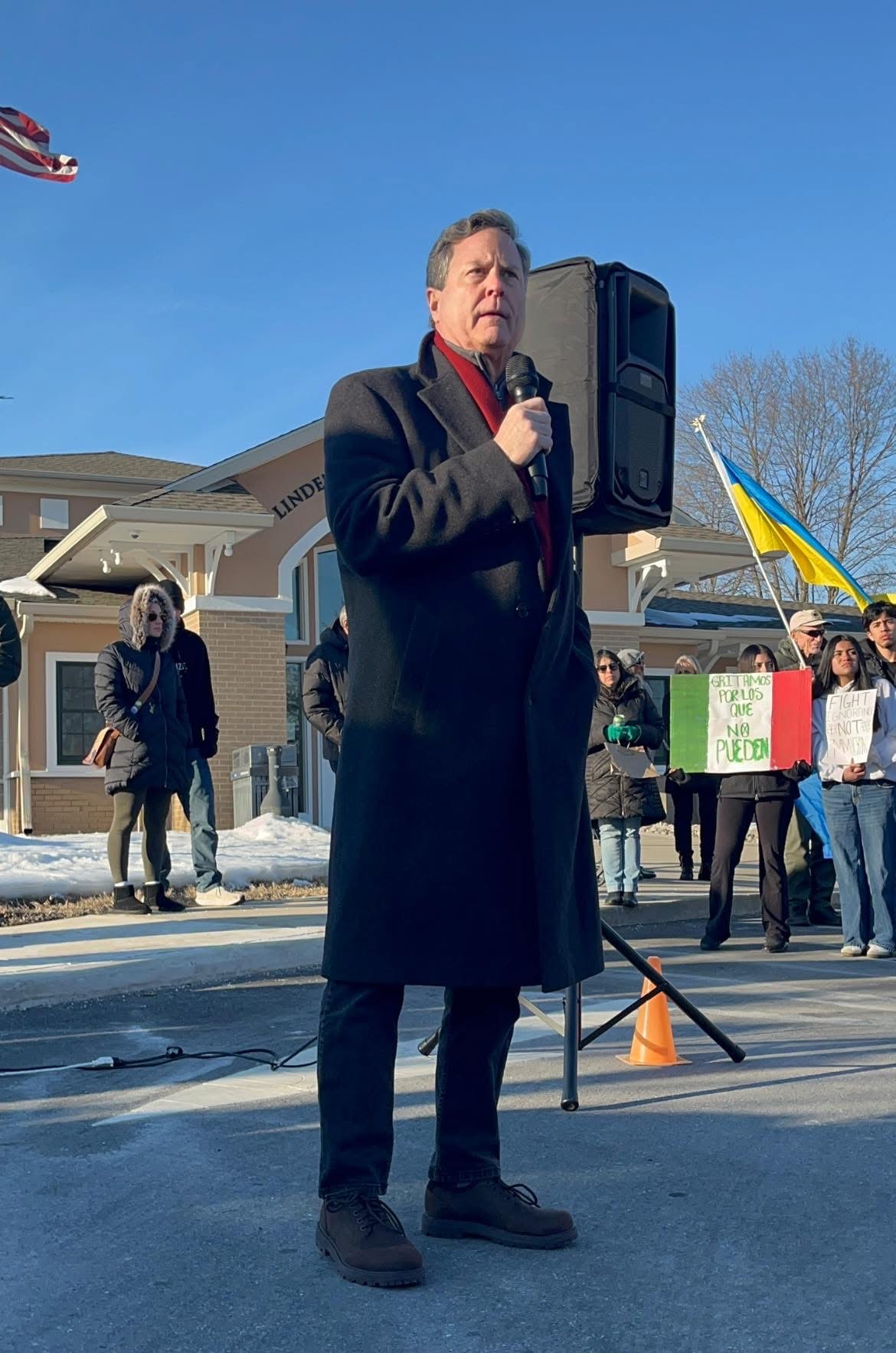
    Sharon Schultz, a left-leaning progressive from South Jersey, attended the protest. Sharon grew up primarily in Detroit and emigrated to New Jersey when she was fourteen. She had attended a protest with her mother for pro-life causes in high school, but this was her first time at an anti-ICE action.

    When Sharon was asked how the atmosphere was at the protest, she shared,

    “Super positive! Lindenwold police were on site, supportive in general. People were energized, lots of Bad Bunny. People driving by were very engaged, lots of positive, but also a good amount of negative, thumbs down, middle fingers and such.”

    Like Sharon, many others are looking to get involved, and Sharon learned about the protest through an Instagram post and confirmed its legitimacy with Cooper River Indivisible. She was looking for ways to get involved and stand up against Trump’s policies, but kept hearing about events after they had happened. She caught this one in time and showed up to support her community.

    Many members of the community cheered for justice, and the main driver of organizing was the strength of Cooper River Indivisible’s individuals.

    At the protest, organizers from Cooper River Indivisible interviewed organizer Tatiana, who had these powerful statements.

  • The 45-Day Countdown: Governor Sherrill Buys Time to Avert NJ Healthcare Collapse

    NJ faces a healthcare cliff: Gov. Sherrill extends emergency rules for APNs & PAs as 9.5M residents face a 45-day countdown to a care disaster.

    We learned in 2020 during the COVID-19 pandemic that healthcare is essential. Millions of people were without work, and countless people died from the disease, which rapidly spread in retirement homes and incarcerated communities. Hospitals were erecting tents in their parking lots to care for patients, and local emergency response teams were burdened around the clock with emergency medical transportation. A lot changed during the pandemic for people seeking care, and telehealth saw a surge never before seen. With that influx of care needed someone had to do it. Advanced Practice Nurses and Physician Assistants played a key role in enabling millions of appointments. Even then, the system is still inundated, and we need more care.

    Groups echo healthcare reform as being essential, but where does the healthcare come from if there is not enough care to go around? Per-person spending jumped to $11,319 by 2023, driven by higher prices and increased utilization. Numbers are slowly coming out showing an even more substantial rise in the cost of care. Between 2020 and 2025, New Jersey prioritized expanding its physician workforce, with over 1,500 medical residents finishing their training in 2024, and around 471 (30%) of them choosing to practice in-state. The number of active Advanced Practice Nurses (APNs) in New Jersey increased by roughly 35%, rising from 12,107 in 2020-2021 to 16,317 in 2023-2024, representing a significant influx of over 4,000 new or newly active APN licenses during that period. Individual state statistics for phycsisan assistants are not available for New Jersey during this period.

    New Jersey’s population has rebounded, reversing post-2020 declines, reaching over 9.5 million by early 2025. From April 2020 to July 2025, the state grew by about 2.8%, largely driven by international immigration despite domestic out-migration, making it one of the fastest-growing states.

    With the increasing population, healthcare needs have grown. During the height of the COVID-19 pandemic, Governor Phil Murphy issued Executive Order No. 112 on April 1, 2020, temporarily waiving the requirement for Advanced Practice Nurses (APNs) and Physician Assistants (PAs) to work under a supervising or collaborating doctor. Just before leaving office, Governor Murphy signed Executive Order No. 415 on January 16, 2026, officially ending the COVID-19 State of Emergency.

    Now, as the crisis looms over care access, what happens? On February 13th, 2026, Governor Mikie Sherrill signed Executive Order No. 13, temporarily extending the COVID-19 State of Emergency. This will allow APNs and PAs to catch up with the new regulations about to take hold.

    “With today’s executive order, we are providing more time for advanced practice nurses and physician assistants to adjust to this new regulatory landscape, delivering on our commitment to make it easier for small businesses to thrive in New Jersey,” said Governor Sherrill. “Many health care professionals across New Jersey are bracing for impact as years-long state of emergency provisions come to an abrupt end. These sudden regulatory changes will have wide-ranging impacts on health care professionals and patients alike – potentially even forcing clinics and small, independent practices to close their doors, making it more difficult for New Jerseyans to access critical health care services.”

    There are over 16,000 APNs in NJ, with 84% in primary care and 7% in mental health, making them essential for covering the 1.86 million residents on Medicaid. Not only do those on Medicaid see an APN, but many others with employer-sponsored or private-sector health insurance also use APN care for affordability and convenience.

    With so many at risk of a catastrophic healthcare disaster in 45 days, will the government take action to codify care?

  • Education | Beyond the Celebration: Facing the Brutal Truths of Black History

    This Black History Month, let’s look at the history of the Black disenfranchisement of a community that built the country we call home.

    The struggle and generational trauma passed down in Black Communities started with The Middle Passage. The maritime journey that brought millions of Africans to the Americas was under brutal conditions.

    The country was built on the ownership of the people, and the government knew that.

    Millions suffered during The Middle Passage, and stories have been passed down through generations, paving the very month we recognize the Black Resistance and protest for equality and equity.

    A famous poet, Robert Hayden, wrote the “Middle Passage” in 1962. (Quotes to emphasize the name).

    The poem begins by naming the slave ships, which are primarily named Desire, Starlight, and Fortune.

    Black People were the cargo. An inhumane act of creating property from humans.

    The poem is illuminating. Text within this block will maintain its original spacing when published

    Jesus, Estrella, Esperanza, Mercy:
    Sails flashing to the wind like weapons,
    sharks following the moils of voices
    shouting, and the weals, the whirlpools of the dead.
    Deep in the festering hold thy father lies,
    of his bones New England pews are made,
    those are altar lights that were his eyes.

    The beginning of the resistance and fight for true freedom.

    The poem begins to describe the testimony of traders and finally The Amistad Rebellion.

    The Amistad Rebellion in 1839 was a revolt on board the Amistad. Led by Cinqué. Hayden signifies this rebellion as a historical event for the Black Community. The people who were considered cargo fought back to gain humanity.

    Poem Excerpt:

    But Cinqué!
    A night-smelling flower of the desert,
    a song of the sun,
    a soul who would not be a slave.

    In 1787, the Constitution included the Three-Fifths Compromise. A dehumanized, codified count of enslaved people as only being worth 3/5 of a person for legislative representation.

    From there followed decades of struggle.

    The Civil War is a turning point in the Black Resistance in America. The war was the deadliest in American history, with roughly 750,000 deaths.

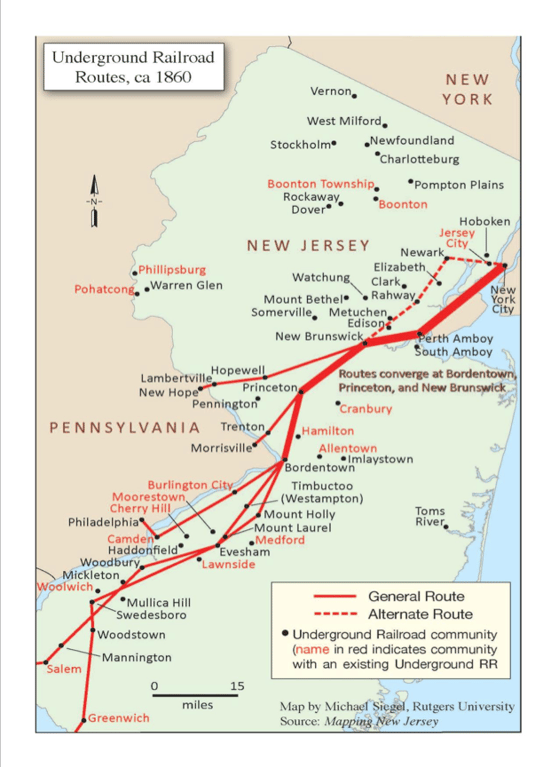
    The Underground Railroad operated primarily during the first half of the 19th century, reaching its peak around 1850.

    Resistance existed as long as slavery existed in the United States. Organizers began gathering in the late 18th century among Quaker communities in Pennsylvania and New Jersey.

    During peak, it is estimated that 1k people per year successfully escaped using the network.

    During the fugitive slave act, the federal law required that even in free states, slaves were captured & returned.

    New Jersey played a critical role in the Underground Railroad due to its geography. Serving as a vital “bridge” between the slave holding states and the South with the safety of New York City and Canada.

    The Greenwich Line crossing was the Delaware Bay, where people landed in Cumberland County or Cape May.

    The Jersey shore provided refuge for those moving toward NYC.

    Committees called Vigilance were the backbone of the movement, providing food, clothing, and legal services.

    Famous conductors include Harriet Tubman (Born in Dorchester County, Maryland), who led 13 trips into Maryland to free enslaved people.

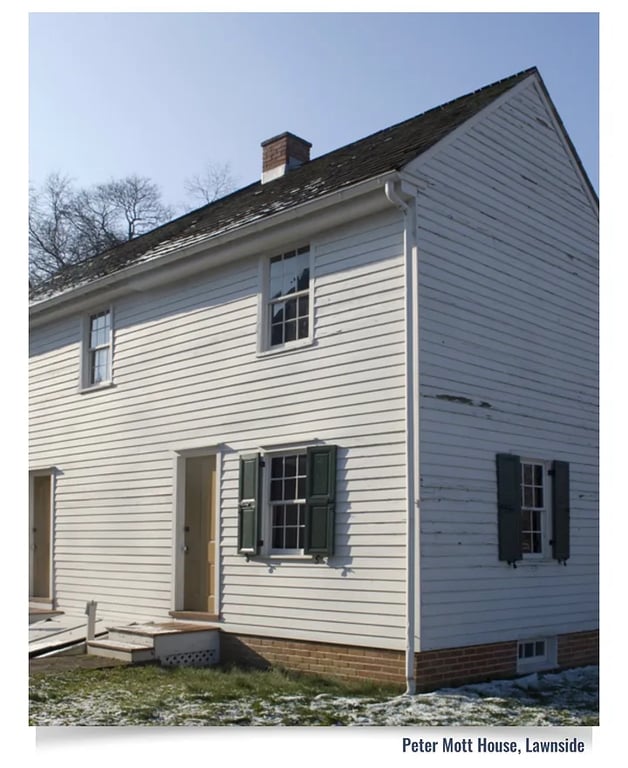
    A lesser-known conductor was Abigail Goodwin, a “Birthright Quaker” committed to abolition so strongly that she was eventually ejected from the Orthodox Quaker Meeting in Salem.

    Some Quakers felt the Underground Railroad was “too radical” or “broke too many laws.” Abigail disagreed, believing human freedom superseded government decree. Famous conductors include Harriet Tubman (Born in Dorchester County, Maryland), who led 13 trips into Maryland to free enslaved people.

    After the war the “Reconstruction” era began from 1865-1877, Black Men saw the right to vote until federal troops withdrew from the south leading to the Jim Crow era a a century of state sanctioned violence which included segregation, disenfranchisement and extrajudicial violence (Lynching, murders, bombings)After the war the “Reconstruction” era began from 1865-1877, Black Men saw the right to vote until federal troops withdrew from the south leading to the Jim Crow era a a century of state sanctioned violence which included segregation, disenfranchisement and extrajudicial violence (Lynching, murders, bombings)

    The foundation of Black History Month began in 1926 as “Negro History Week” in February by historian Carter G. Woodson and the Association for the Study of Negro Life and History.

    Woodson chose February and the second week to be precise because it encompassed the Birthdays of Abraham Lincoln (Feb 12th) and Fredrick Douglass (Feb 14th)

    Two figures celebrated in Black Communities.The foundation of Black History Month began in 1926 as “Negro History Week” in February by historian Carter G. Woodson and the Association for the Study of Negro Life and History.

    Woodson chose February and the second week to be precise because it encompassed the Birthdays of Abraham Lincoln (Feb 12th) and Fredrick Douglass (Feb 14th)

    The following years, before the shift to a month and the recognition nationally in 1976, were superseded by the civil rights movement. A act of resistance which resulted in rebellions fueled by resisters who dignified themselves as humans.

    Thousands of people died.

    Two notable Figures include Ross Parks and Martin Luther King Jr.

    During the 1976 United States Bicentennial, President Gerald Ford officially recognized Black History Month for the first time at a federal level.

    He urged Americans to “seize the opportunity to honor the too-often neglected accomplishments of Black Americans in every area of endeavor throughout history”.

    In 1986, it was codified into law.

    Law 99-244During the 1976 United States Bicentennial, President Gerald Ford officially recognized Black History Month for the first time at a federal level.

    He urged Americans to “seize the opportunity to honor the too-often neglected accomplishments of Black Americans in every area of endeavor throughout history”.

    Since 2026 would mark the 100th anniversary of Carter G. Woodson’s original 1926 version, it is the first time a president has not recognized the month in decades.

    Donald Trump has caused undue harm to the black community by perpetuating stereotypical culture and racism.

    We must all fight to continue this pledge to honor the history of Black People in America and end systemic oppression.